Showing posts with label vocabulary. Show all posts

Tuesday, March 18, 2025

New Vocab Gym Activities

Road to Grammar's "Vocab Gym" is a series of short vocabulary topics for self-study or for teachers to use with their classes.

Each one has five or more vocabulary items presented as a MCQ quiz, with a picture and audio clip.

The two new topics added this month are WAYS TO COOK EGGS and WAYS TO COOK POTATOES.

The links are below. Enjoy!

Ways to cook eggs:

http://www.roadtogrammar.com/vocabgym/?46

Ways to cook potatoes:

http://www.roadtogrammar.com/vocabgym/?47


Wednesday, December 18, 2024

Custom GPT 3: Phrasal Verb Master

I'm putting together a suite of custom GPTs to support ESL learners.

This is custom GPT number three.

This GPT will help you practice phrasal verbs. You can choose one of three activities:

1 MCQ
2 Fill in the blanks
3 make a sentence

The GPT will give you feedback and explain if you've made a mistake. There are hundreds of phrasal verbs to practice.

Teachers: try this with your students. Learners: try it by yourself!

(ChatGPT account required).

URL:

https://chatgpt.com/g/g-674fcd57b0908191a3a1976f19ae8a94-phrasal-verb-master-by-road-to-grammar

Sample:


Tuesday, December 17, 2024

Custom GPT 2: Make a Sentence

I'm putting together a suite of custom GPTs to support ESL learners.

This is custom GPT number two.

This GPT will give you a word and you need to make a sentence with it. Then, the GPT will give you feedback on the sentence. Words are at intermediate level and above.

It's a very simple app, but a very effective way to improve your vocabulary. For example, if you practice 5-10 words per day, you will definitely see an improvement within a short time.

Teachers: try this with your students. Learners: try it by yourself!

(ChatGPT account required).

URL:

https://chatgpt.com/g/g-674e7b94351c8191ada7fa287c2220ab-make-a-sentence-by-road-to-grammar

Sample:


Friday, November 22, 2024

Listen Up!

To continue the series of context exercises on Road to Grammar, here is a listening context activity.

Listen Up! features 100 vocabulary items with three audio clips for each one. The user listens to the audio clips and guesses the meaning of the vocabulary item from the context.

This activity sharpens your listening skills, study skills and vocabulary repertoire. It is most suitable for CEFR B1-B2 levels.

Link: http://roadtogrammar.com/listenup/

Screenshots:


Tuesday, January 23, 2024

Audio Support for Vocab Gym

All of the picture-based vocabulary quizzes in Road to Grammar's Vocab Gym now come with audio examples.

After you have answered a question, an audio icon will appear (see picture below) and you can click this to hear the audio.

You can find the Vocab Gym activity here.


Wednesday, June 29, 2022

Three Ways to Be More Expressive in English


When you learn English at a basic level, your goal is simply to understand what people say and engage in simple, everyday conversations.

As you move up to intermediate level, you gain the ability to carry out a range of functions in English. For example, you should be able to write a work email or give people instructions.

However, the jump from intermediate to advanced level is a little different. You need to learn the nuances of English. You need to express yourself naturally, like a native speaker. In short, you need to be more expressive.

One way to be more expressive in English is to learn and use idioms. An idiom is any word or expression with a special meaning, such as 'a piece of cake' (easy) or 'raining cats and dogs' (heavy rain).

Another way is to learn strong (emphatic) adjectives. A word like 'good' is a normal adjective. Words like fantastic, wonderful, terrific and excellent are strong adjectives. A word like 'scared' is a normal adjective. Stronger versions are terrified, horrified or petrified.

Just like we have strong adjectives, we have strong verbs and specific action verbs. For example, 'walk' is a general verb, but if we want to be more specific about how a person is walking, we can use words like stroll, amble, swagger, march or wander.

These are three simple ways you can boost your vocabulary into advanced level!

To practice idioms, click here.
To practice emphatic adjectives, click here.
To practice specific action verbs, click here.

Wednesday, February 16, 2022

New Vocabulary Activity: Learn5

 Available now, there is a new vocabulary activity on Road To Grammar.

The purpose is to learn five words at a time. The way it works it like this:

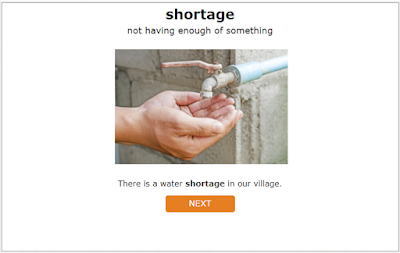
1 Review flashcards of five words. The flashcards have a picture example and the definition.

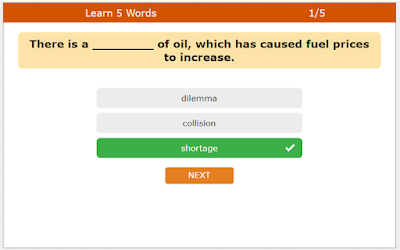
2 Then try five MCQ questions on the words you have just learned.

The activity is randomized from a bank of 300+ words, so you can try the activity as many times as you like.

Most of the words are from the Road To Grammar Instagram account, so you may recognize them if you are a follower.

More words will be added later.

The link for this activity is:

www.roadtogrammar.com/learn5

Screenshots:


Friday, October 23, 2020

Halloween

Halloween is coming up and I vant to drink your blood! Err, I mean I want to share some Halloween vocabulary. Click on the link or the picture below:

http://www.roadtogrammar.com/microlessons/index.html?&1&adb


Friday, May 10, 2019

Words and Phrases for Talking about Money

Here is a new picture-based activity with words and phrases for talking about money. There are twenty phrases in total and it is suitable for A2-B2 level.

Below are screenshots from the activity on a laptop and phone.

Try the activity here: http://roadtogrammar.com/talkingmoney/


Thursday, February 08, 2018

Kudos

Here is an interesting English word:

Kudos

It is interesting right away because, somehow, it does not even look
like an English word. In fact, it is a loan word from Greek.

It has a great sound to it; it is pronounced 'koodose'.

It is a way of giving praise or congratulations to someone. Here are
some sample sentences:

Kudos for losing so much weight.
Kudos to Tom for standing up to the office bully.
Lisa deserves kudos for getting a place at Oxford when everyone said
she wouldn't be able to do it.

How can this word help you as an English learner? Listen out for it
and when you feel confident enough, try using it in your own speech.
Your teacher will be impressed!

Friday, April 21, 2017

What is the size of a native speaker’s vocabulary?

What is the size of a native speaker’s vocabulary?

The answer is not so simple. There are two sides to a person’s vocabulary. The first is the number of words they use on a daily basis. This is their active vocabulary. The second is the number of words that they recognise, but may not use themselves. This is their passive vocabulary.

For instance, most native speakers would understand the word ‘ajar’, which means ‘slightly open’, as in the door is ajar. But it is probably not a word that they use very much. Perhaps they never use it!

Lexicographer Susie Dent says that most native speakers of English have an active vocabulary of 20,000 words and a passive vocabulary of 40,000. I have seen other sources that claim most people have an active vocabulary of as little as 12,000 words.

Still, for an English learner, that is a lot of words to learn to catch up with the natives.

But there is a way to improve your vocabulary without learning new words. That is, to transfer some words from your passive vocabulary into your active vocabulary.

For example, you might be fond of the word ‘maybe’, but you can always try to use ‘perhaps’ more. Perhaps you usually write For example. You could try using For instance instead.

It’s all about making an effort and stepping outside of your comfort zone.

Saturday, September 01, 2012

New quiz: Household items

There's a new quiz on Road To Grammar.

This time, it is a vocabulary quiz to help beginners learn the names of household items. The quiz has 28 household items to learn, with accompanying pictures.

You can try the quiz at: www.roadtogrammar.com/householditems

Screenshots:


Tuesday, January 18, 2011

A really fast dictionary

I recently found this excellent site:


Ninja Words claims to be 'A really fast dictionary... fast like a ninja.'

However, it's not the speed that is interesting, but the ability to generate word lists very quickly. Let's say that you want to get the definition of 'geography' but without using the search function, you can just type the following in the address bar:


So far so good? Now to generate a list of definitions, we just need to add commas. Try this link:


So you could use this to generate a word list, copy, paste and print it out or pass the link on to students. Don't forget to use a service like http://bit.ly if you need to shorten it.


Monday, November 09, 2009

Where is the word OK from?

(From Yahoo Answers)

1839, only survivor of a slang fad in Boston and New York c.1838-9 for abbreviations of common phrases with deliberate, jocular misspellings (cf. K.G. for "no go," as if spelled "know go"); in this case, "oll korrect." Further popularized by use as an election slogan by the O.K. Club, New York boosters of Democratic president Martin Van Buren's 1840 re-election bid, in allusion to his nickname Old Kinderhook, from his birth in the N.Y. village of Kinderhook. Van Buren lost, the word stuck, in part because it filled a need for a quick way to write an approval on a document, bill, etc. The noun is first attested 1841; the verb 1888. Spelled out as okeh, 1919, by Woodrow Wilson, on assumption that it represented Choctaw okeh "it is so" (a theory which lacks historical documentation); this was ousted quickly by okay after the appearance of that form in 1929. Okey-doke is student slang first attested 1932. Greek immigrants to America who returned home early 20c. having picked up U.S. speech mannerisms were known in Greece as okay-boys, among other things.

H.L. Mencken once described "O.K." as "the most successful of Americanisms," an estimation verified by U.S. troops during the Second World War, who reported encountering the phrase all over the world. Of all the scores of theories (and sub-theories) as to the origin of "O.K.," the most widely heard traces "O.K." to the "O.K. Club," a political committee supporting Martin Van Buren's unsuccessful bid for the Presidency in 1840. The "O.K.," it is said, was short for "Old Kinderhook," Van Buren's nickname.

It appears that this theory is not so much wrong (the "O.K. Club" certainly existed) as it is incomplete. Chances are good the Van Buren's partisans would never have named their club "O.K." had the phrase not already been widely known as an abbreviation of "oll korrect," a humorous misspelling of "all correct." American speech in the early 1800s was awash in similar abbreviations, two of which, "N.G." ("no good") and "P.D.Q." ("Pretty Damn Quick"), are still heard today.

Ironically, while "O.K." didn't save Van Buren's campaign, the campaign gave "O.K." a new lease on life -- until then, it had never been as popular as a competing phrase, "O.W." (for "oll wright"). (By the way, before we start feeling too superior to the cornball 1800s, is "oll wright" really any worse than the "excuuuse me!" or "not!" fads of a few years ago?).

OK is without doubt the best-known and widest-travelled Americanism, used and recognised even by people who hardly know another word of English. Running in parallel with its popularity have been many attempts to explain where it came from — amateur etymologists have been obsessed with OK and theories have bred unchecked for the past 150 years.

Wednesday, October 14, 2009

Prescribe vs Proscribe

To prescribe is to advise or recommend someone to do something, or to impose something authoritatively.

A doctor can prescribe a certain medicine for you (recommend that you take it) by writing you a prescription for it (i.e. its name and details of how you should take it), to be given to a pharmacist.

In addition, he may prescribe (advise) that you take some exercise, e.g. a brisk walk for half an hour daily, for your general health.

When a law prescribes something, it means it imposes something authoritatively on everyone in the country. For example, in certain countries, the law prescribes that parents are responsible for the actions of their non-adult children. So if their children do something against the law, the parents are taken to court and tried.

To proscribe something, on the other hand, means to forbid something through the law of a country, or regulations of certain bodies.

For example, athletes taking part in Olympic games are proscribed from taking certain drugs to improve their performance.

As the Concise Oxford Dictionary (1995) points out, it is important to see the difference between prescribed drugs (recommended by a doctor) and proscribed drugs (banned substances).

(courtesy of thestar.com.my)

Friday, July 24, 2009

A new word every 98 minutes

New words are coined in English all the time. However, I didn't realize how many until I read this article on the BBC website.

Apparently a new word is created every 98 minutes and there are already one million words in English.

Wow!

IELTS Reading Practice

Here is a new activity: a series of fifteen short reading passages with accompanying sentence analysis questions. This sort of practice is p...